
Conference on Advances in Catalysis
for Energy and Environment - 2026
CACEE -2026
Tuesday 15th - Friday 18th, December, 2026
Venue: Tata Institute of Fundamental Research (TIFR), Mumbai, India


Dr. Homi J. Bhabha
Founding Director of Tata Institute of Fundamental Research, Mumbai
“The key to national prosperity, apart from the spirit of the people, lies in the modern age, in the effective combination of three factors, technology, raw materials and capital, of which the first is perhaps the most important, since the creation and adoption of new scientific techniques can, in fact, make up for a deficiency in natural resources, and reduce the demands on capital. But technology can only grow out of the study of science and its applications.”
- Opening statement of the GOI’s Scientific Policy Resolution, 1958, of which he was one of the principal architects.
ABOUT CACEE-2026
Addressing the escalating challenges of climate change, sustainable energy, and environmental resilience demands a transformative approach rooted in chemistry and allied disciplines. The Conference on Advances in Catalysis for Energy and Environment (CACEE-2026) is envisioned as a global platform to bring together leading researchers across chemistry, materials science, spectroscopy, engineering, and computational science to drive the next generation of solutions.
Building on the strong foundation of previous editions, CACEE-2026 aims to foster in-depth discussions on advancing breakthrough catalyst design through fundamental insights.
The conference will emphasize the rational design of next-generation catalytic materials for electro-, thermo-, and photo-catalytic pathways, spanning defect engineered systems, single and multimetallic architectures, and nanostructured & hybrid multifunctional materials. It will highlight the pivotal role of interfaces, strong metal–support interactions, plasmonic, and electronic structure modulation in controlling activity, selectivity, and stability. Particular focus will be placed on light–matter interactions for solar-driven transformations, and their integration with renewable energy systems for sustainable chemical production.
Beyond materials design, CACEE-2026 will explore advanced approaches to understanding catalytic processes, including operando and in-situ characterization, state-of-the-art spectroscopy and microscopy, theoretical & computational modeling and data-driven and AI-assisted catalyst discovery. The conference will also address reactor engineering, process intensification, and the integration of catalysis across scales.
Through interdisciplinary exchange and critical dialogue, CACEE-2026 aims to accelerate the journey from molecular-level understanding to real-world energy and environmental solutions.
The CACEE Journey Timeline
Successfully adapted to the COVID-19 global pandemic by holding the conference virtually thereby, maintaining strong participation, engagement and feedback.
CACEE-2020
SCIENTIFIC THEMES
CACEE-2026 will cover a broad spectrum of cutting-edge topics spanning fundamental chemistry to translational technologies, with a strong emphasis on addressing energy, environmental, and climate challenges.
Innovative Materials & Catalyst Design
-
Synthesis of next-generation multimetallic, single-atom, and cluster catalysts.
-
Defect engineering and electronic structure modulation.
-
Nanostructured, plasmonic, and hybrid catalytic architectures.
-
Porous frameworks and supramolecular materials
Light-Matter Interactions & Photocatalysis
-
Fundamentals of photochemistry and solar-driven catalytic processes.
-
Plasmonic catalysis and the ultrafast dynamics of hot carriers.
-
Enhancing chemical reactivity through light-matter interactions.
-
Development of hybrid photo-thermal and photo-electrochemical systems.
Advanced Characterization & Mechanistic Insights
-
In-situ and operando techniques for mechanistic understanding.
-
Advanced spectroscopy (XAS, DRIFTS) and theoretical modeling.
-
High-resolution electron microscopy (TEM, STEM, EELS, 4D-STEM).
-
AI-assisted methods for catalyst characterization and mechanism.
AI, Data Science & Digital Chemistry
-
Machine learning applications in materials and catalyst design.
-
High-throughput experimentation and rapid catalyst screening.
-
Predictive computational modeling of complex catalytic systems.
-
Overall digitalization of chemical research and industrial processes.
Chemistry for Climate Change Mitigation
-
Advanced CO2 capture, storage, and separation technologies.
-
Catalyst design for CO2 activation.
-
Conversion of CO2 into fuels and value-added chemicals.
-
Coupling carbon conversion with renewable energy systems.
Plastic Waste & Circular Carbon Economy
-
Catalytic recycling and molecular mechanisms of plastic degradation.
-
Advanced methodologies for polymer breakdown and chemical upcycling.
-
Rational design of eco-friendly and inherently recyclable polymers.
-
Thermodynamics and energy efficiency of chemical recycling processes.
Sustainable Energy & Green Chemistry
-
Solar energy conversion and artificial photosynthesis.
-
Electrochemical conversion processes.
-
Production and storage of green hydrogen, and ammonia.
-
Valorization of biomass and sustainable biofuel generation.
Reactor Engineering & Scale-Up
-
Design of advanced photo-, electro-, and thermo-catalytic reactors.
-
Continuous process intensification and efficiency optimization.
-
Scale-up strategies and the development of pilot plants.
-
Integration of new catalytic processes with industrial infrastructure.
Industry, Startups & Translation
-
Fostering productive industry and academic research collaborations.
-
Navigating technology transfer and commercialization pathways.
-
Supporting startups focused on catalysis and energy technologies.
-
Translating laboratory-scale chemical discoveries to industrial deployment.
Speakers
Plenary Speakers


Keynote Speakers


Invited Speakers


The speakers’ list will be updated continuously.......

Schedule & Abstract Book
Tuesday
15th December 2026
(First Day)
Wednesday
16th December 2026
(Second Day)
Thursday
17th December 2026
(Third Day)
Friday
18th December 2026
(Final Day)

Abstract Submission
The abstract submission deadline for both CACEE 2026 and the CO₂India Special Symposium is 20 August 2026.
Abstract submission is officially closed.
Note for current participants: If you have already submitted an abstract or registered for CACEE 2026, no further action is required. Your existing registration and abstract will automatically be considered for this special symposium.
Poster Abstract Submission
EXPLORE, ENGAGE, AND INNOVATE: Submit your abstract now to showcase your research in a poster presentation at CACEE-2026 and CO2India Symposium! Share your innovative findings, engage with leading experts, and gain valuable insights. Don’t miss this opportunity to contribute to the future of catalysis – submit your abstract today!
To maintain formatting consistency across all scientific proceedings, you must use the official conference templates provided below.
To recognize outstanding research, we will be presenting several awards for poster presentations.
CO₂India Special Symposium at CACEE 2026
18 December 2026 | TIFR Mumbai
We are delighted to announce that the 𝐟𝐢𝐧𝐚𝐥 𝐝𝐚𝐲 𝐨𝐟 𝐂𝐀𝐂𝐄𝐄 𝟐𝟎𝟐𝟔 (𝟏𝟖 𝐃𝐞𝐜𝐞𝐦𝐛𝐞𝐫 𝟐𝟎𝟐𝟔) at 𝐓𝐈𝐅𝐑 𝐌𝐮𝐦𝐛𝐚𝐢 will be dedicated to the 𝐂𝐎₂𝐈𝐧𝐝𝐢𝐚 𝐒𝐩𝐞𝐜𝐢𝐚𝐥 𝐒𝐲𝐦𝐩𝐨𝐬𝐢𝐮𝐦, bringing together researchers working on Carbon Capture, Utilization and Storage (CCUS) and Green Hydrogen.
This special symposium aims to provide a vibrant platform for scientific exchange, showcase cutting-edge research, and foster collaborations across academia, national laboratories, and industry.
We invite abstract submissions in the following categories:
𝐏𝐨𝐬𝐭𝐞𝐫 𝐏𝐫𝐞𝐬𝐞𝐧𝐭𝐚𝐭𝐢𝐨𝐧𝐬
• Open to students and postdoctoral researchers
• Present your latest research in a dedicated poster session.
• Interact with leading experts in CCUS and Green Hydrogen.
𝐈𝐧𝐯𝐢𝐭𝐞𝐝 𝐋𝐞𝐜𝐭𝐮𝐫𝐞 – 𝐒𝐡𝐨𝐫𝐭 (𝐈𝐋-𝐒)
• Open to faculty members, scientists, and industry researchers.
• Submit your latest research as an IL-S abstract.
Abstract Submission for 𝐈𝐧𝐯𝐢𝐭𝐞𝐝 𝐋𝐞𝐜𝐭𝐮𝐫𝐞 – 𝐒𝐡𝐨𝐫𝐭 (𝐈𝐋-𝐒)
Faculty members, scientists, and industry researchers are encouraged to submit their latest research for a short Invited Lecture (IL-S). The Scientific Committee will evaluate all submissions and invite the authors of selected abstracts to deliver oral presentations. Please note that conference registration is restricted exclusively to those who receive an invitation after their abstract has been reviewed.
Registrations
Registrations are closed as the deadline was till 11th September, 2026
Regular Registration Fees (CACEE-2026)
CO2India Membership
Note: If you encounter difficulties accessing CO2India on Wi-Fi, we recommend using mobile data instead
CACEE-2026 Registration Fee Payment Details
Important Registration Notice:
-
𝐈𝐧𝐯𝐢𝐭𝐞𝐝 𝐋𝐞𝐜𝐭𝐮𝐫𝐞 – 𝐒𝐡𝐨𝐫𝐭 (𝐈𝐋-𝐒): Registration requires an invitation from the organizing committee (cacee@tifr.res.in) after your abstract is reviewed.
-
Poster Presenters: Please register only when you have received an official abstract acceptance email from the organizing committee (cacee@tifr.res.in).
-
If you are not interested in presenting a poster or IL-S, you may proceed to register immediately.
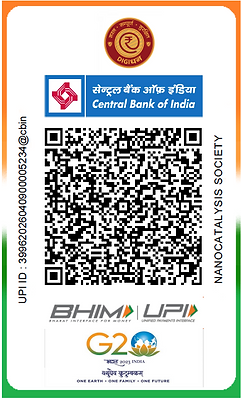
Please pay your CACEE-2026 fee via bank transfer or UPI QR, then register by clicking the button below.
Bank Details For CACEE-2026 Registration
Account Name: Nanocatalysis Society
Account Number: 5234937382
Bank Name: Central Bank of India
Branch Name: TIFR COLABA
IFSC Code: CBIN0283996
OR
Registration Fee Includes Lunches, Gala Dinner, Snacks, Tea, and a Registration kit.
Note : All Indian citizens studying or working abroad are required to register as international participants.
Students
Indian Delegate (CO2India Member):
₹ 6,000
Indian Delegate (Non - CO2India Member):
₹ 7,000
Student
International Delegate:
US $ 350
Post Docs
Indian Delegate (CO2India Member):
₹ 9,000
Indian Delegate (Non - CO2India Member):
₹ 13,000
Student
International Delegate:
US $ 550
Faculty/Scientists
Indian Delegate (CO2India Member):
₹ 17,000
Indian Delegate (Non - CO2India Member):
₹ 25,000
Student
International Delegate:
US $ 650
Industry
Indian Delegate (CO2India Member):
₹ 32,000
Indian Delegate (Non - CO2India Member):
₹ 40,000
Student
International Delegate:
US $ 850
Students
Indian Delegate (CO2India Member):
₹ 5,000
Indian Delegate (Non - CO2India Member):
₹ 6,000
International Delegate:
US $ 300
Student
Post Docs
Indian Delegate (CO2India Member):
₹ 8,000
Indian Delegate (Non - CO2India Member):
₹ 12,000
International Delegate:
US $ 500
Student
Faculty/Scientists
Indian Delegate (CO2India Member):
₹ 16,000
Indian Delegate (Non - CO2India Member):
₹ 24,000
International Delegate:
US $ 600
Student
Industry
Indian Delegate (CO2India Member):
₹ 31,000
Indian Delegate (Non - CO2India Member):
₹ 39,000
International Delegate:
US $ 800
Student
Convener

Prof. Vivek Polshettiwar

TIFR Mumbai
Advisory Committee
-
Prof. A. K. Tyagi (HBNI, Mumbai India)
-
Prof. Alberto Naldoni (University of Turin, Italy)
-
Prof. Alessandro Alabastri (Rice University, USA)
-
Prof. Alexis Bordet (MPI CEC, Germany)
-
Prof. Amrit Venkatesh (University of Virginia, USA)
-
Prof. Ananth Govind Rajan (IISc, India)
-
Prof. Aniruddha Bhalchandra Pandit (ICT, Mumbai)
-
Dr. Ankur Bordoloi (CSIR-IIP, India)
-
Dr. Aram Bugaev (PSI, Switzerland)
-
Prof. Ashok Kumar Ganguli (IISER Berhampur, India)
-
Dr. Ayan Maity (Weizmann Institute of Science, Israel)
-
Prof. Chinmoy Ranjan (IISc, India)
-
Prof. Dayne F. Swearer (Northwestern University, USA)
-
Prof. Deepa Khushalani (TIFR Mumbai, India)
-
Prof. Dibyajyoti Ghosh (IIT, Delhi, India)
-
Prof. Ewa Kowalska (Jagiellonian University, Poland)
-
Prof. Günther Rupprechter (TU Vien, Austria)
-
Prof. Haresh Manyar (Queen's University, Northern Ireland)
-
Prof. Ive Hermans (Johns Hopkins University, USA)
-
Prof. Jeong Young Park (KAIST, South Korea)
-
Dr. Joyee Mitra (CSIR-CSMCRI, India)
-
Prof. Kalaivanan Nagarajan (TIFR Mumbai, India)
-
Prof. Laura Fabris (Politecnico di Torino, Turin, Italy)
-
Dr. Marcin Kobielusz (Jagiellonian University, Poland)
-
Prof. Mita Dasog (Dalhousie University, Canada)
-
Prof. Mohammad Ali Haider (IIT Delhi - Abu Dhabi, UAE)
-
Prof. Neetu Jha (ICT, Mumbai)
-
Prof. Pradip Pachfule (SNBNCBS, India)
-
Prof. Prashanth Menezes (TU Berlin, Germany)
-
Prof. Preeti Aghalayam (IIT Madras, India)
-
Dr. Rakhi R B (CSIR-NIIST, India)
-
Prof. Ravi Gudi (IIT Bombay, India)
-
Dr. Sandip De (BASF SE, Germany)
-
Prof. Saumyakanti Khatua (IIT Gandhinagar, India)
-
Prof. Sayan Bhattacharyya (IISER Kolkata, India)
-
Prof. Sebastian C. Peter (JNCASR, India)
-
Prof. Shobha Shukla (IIT Bombay, India)
-
Prof. Somnath Biswas (TIFR Mumbai, India)
-
Prof. Sonali Das (IIT Bombay, India)
-
Prof. Soumyabrata Roy (IIT Kanpur, India)
-
Prof. Thallada Bhaskar (CSIR-AMPRI, India)
-
Prof. T. N. Narayanan (TIFR-H, India)
-
Prof. Troels Skrydstrup (Aarhus University, Denmark)
-
Prof. Uttam Manna (IIT Guwahati, India)
-
Prof. Yamijala Chaitanya Sharma (IIT Madras, India)
-
Prof. Priyanka Verma (IIT Delhi, India)
Local Organizing Committee

Prof. Vivek Polshettiwar
Convener, CACEE-2026
Professor, TIFR Mumbai

Ms. Sushma Kundu
Scientific Officer, DCS, TIFR Mumbai

Ms. Gunjan Sharma
Research Scholar, DCS,
TIFR Mumbai

Ms. Charvi Singhvi
Research Scholar, DCS,
TIFR Mumbai

Mr. Rohit Bansal
Research Scholar, DCS,
TIFR Mumbai

Dr. Saibalendu Sarkar
ANRF-NPDF Researcher, DCS, TIFR Mumbai

Mr. Jaipreet Singh
Research Scholar, DCS,
TIFR Mumbai

Ms. Manisha Dolai
Research Scholar, DCS,
TIFR Mumbai
Contact Us
Sponsorship
Sponsors will gain an incredible amount of visibility and networking opportunities to meet their Business, Corporate and Human Resource objectives.
Platinum
Rs - 10 Lakhs (Five delegates, entrance tickets, advertisement at the main gate at the entrance and banner, logo on the website, conference poster and abstract book, company brochure in the delegate bags, and exhibitors cubicle)
Gold
Rs - 5 Lakhs (Three delegates, entrance tickets, advertisement at the main gate at the entrance, logo on the website, conference poster and abstract book, company brochure in the delegate bags, and exhibitors cubicle)
Silver
Rs - 3 Lakhs (Two delegates, entrance tickets, logo on the website, conference poster and abstract book, and exhibitors cubicle)
Bronze
Rs - 1 Lakh (One delegate, entrance tickets, logo on the website, conference poster and abstract book)

Accommodation
Accommodation should be arranged by participants themselves, preferably well in advance. For the most convenient daily commute to the TIFR campus, we highly recommend searching for hotels in the following South Mumbai regions:
-
Colaba & Cuffe Parade: Closest to the venue (approx. 10–15 minutes by taxi).
-
Gateway of India & Fort: Historic districts with excellent dining options (approx. 15–20 minutes).
-
Nariman Point & Marine Drive: Scenic seafront locations with premium hotels (approx. 20–25 minutes).
-
Churchgate & CSMT: Major transit hubs ideal for budget and mid-range options (approx. 25–30 minutes).

Venue
CACEE 2026 will be hosted at the Tata Institute of Fundamental Research (TIFR) in Mumbai. Situated on a lush, seaside campus overlooking the Arabian Sea, TIFR stands as one of India’s oldest and most premier institutions for advanced scientific research, offering an inspiring environment for academic exchange.
As India’s financial and cultural capital, Mumbai serves as the country’s primary international gateway, offering seamless global flight connectivity for visiting researchers. Furthermore, December is universally considered the best time to visit the city. The post-monsoon climate brings mild temperatures, clear skies, and cool sea breezes, making it the perfect season to explore Mumbai's rich architecture, historic landmarks, and vibrant culinary scene after conference hours.
Reaching TIFR
The Tata Institute of Fundamental Research is located at the southern tip of Mumbai in Navy Nagar, Colaba. Because the campus is situated at the very end of the road past the Navy Nagar Bus Terminus, we recommend using Google Maps for exact routing.
Arriving by Air:
TIFR is approximately 25 km from the Domestic Airport (Terminal 1) and 30 km from the International Airport (Terminal 2). You have two primary transit options:
The Metro (Recommended): Take Metro Line 3 (Aqua Line) directly from Terminal 1 or Terminal 2 to the final station at Cuffe Parade. From Cuffe Parade, it is a short 5-minute taxi ride to the TIFR main gate.
Ride-Sharing (Uber or Ola): App-based taxis are readily available at both airport terminals. For the fastest route, instruct your driver to take the Bandra-Worli Sea Link and the Coastal Road.
Arriving by Train:
If you are traveling via the regional railway network, the two closest major transit hubs are CSMT (Victoria Terminus) and Churchgate Station. Both are approximately 5 km from the institute. Simply hire a local taxi outside the station to bring you directly to the campus.